
 Regular Shipping is
  Currency
converter
Currency
converter join
our Newsletter
join
our Newsletter
 "A Ship's Camel"Sopwith Camel (Naval)By : Deborah Susan Jones : Editor"This
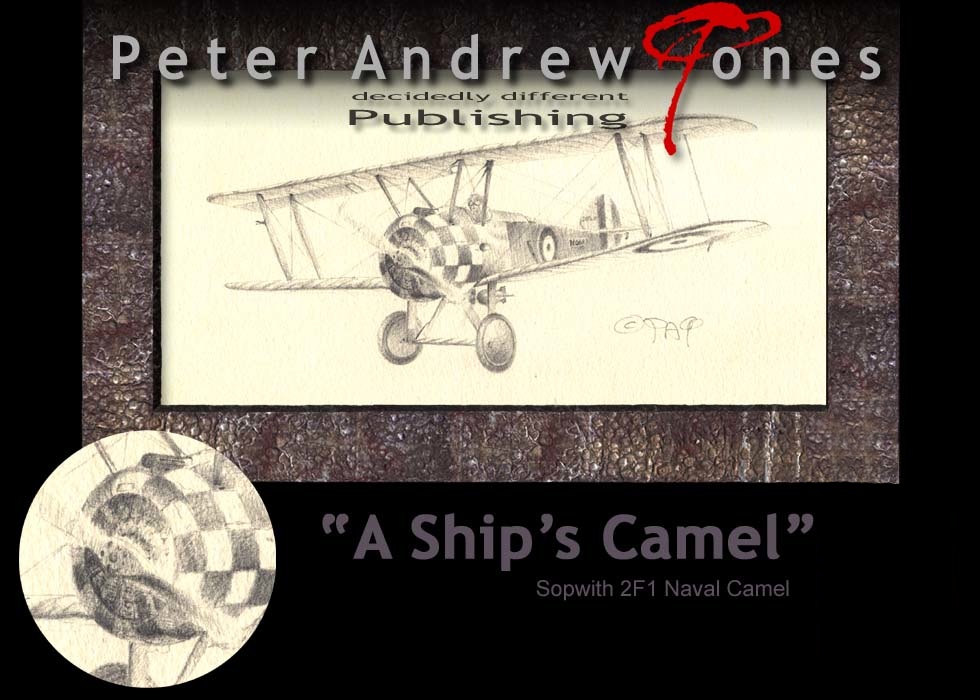
week's Legendary Art is one of Peter's Aviation investigative
drawings examining the blue and white checkered Sopwith 2F1, Ship's
Camel as flown by Captain Bernard Arthur Smart from a converted large
cruiser HMS Furious in 1917.This
aircraft was one of seven launched from HMS Furious on July 19 1917 as
part of the first carrier air strike in history, a British bombing raid
mounted by the Royal Navy and Royal Air Force officially designated
Operation F.7, the target being the the Imperial German Navy's
airship base at Tondern in Germany. The aircraft were specially
configured for the mission with bomb racks and bomb sights, and the
Lewis guns were left behind to save weight. The raid was a success with
two Zeppelins being destroyed in their sheds by the 50-pound bombs
dropped by the Camels. Only two of the Camels managed to return to
Furious, one of which was Smart's aircraft but they destroyed two
German Zeppelins, L.54 and L.60 plus a captive balloon for the
loss of only one pilot while Tondern was abandoned as an active base,
and ordered to be used only as an emergency landing site. Captain Smart
was awarded the Distinguished Service Order for this exploit.The
Sopwith 2F1 Camel a was naval version of the famous standard Sopwith
Camel. Ironically Peter's involvement with Naval Aviation subjects
originates from his involvement with and creation of a project for The
Royal Air Force Benevolent Fund in 1990 on the 50th anniversary of The
Battle of Britain.At
the time he created a number of paintings for a corporate calendar and
it was during the creation of the works that the Artist's
brother-in-law, then a Royal Navy Helicopter pilot, began a friendly
rebuke concerning the lack of artistic portrayal by Aviation Artists of
the heroic exploits of many brave naval pilots.Thus
is was that the Artist began research of naval aviation history which
inevitably led to this issue's subject matter, Commander Smart's Camel
from the1917 mission, and an investigative sketch (visual) to explore
the intrinsic nature of the naval variant of the aeroplane and
specifics relating to that particular event, such as the absence of a
Lewis Gun and the very distinctive checkerboard markings on the engine
cowl, characterisation being a major aspect of the Artist's "style".The drawing is, of course, a
preparatory work for a major oil painting that came later.
"A Ship's Camel"Sopwith Camel (Naval)By : Deborah Susan Jones : Editor"This
week's Legendary Art is one of Peter's Aviation investigative
drawings examining the blue and white checkered Sopwith 2F1, Ship's
Camel as flown by Captain Bernard Arthur Smart from a converted large
cruiser HMS Furious in 1917.This
aircraft was one of seven launched from HMS Furious on July 19 1917 as
part of the first carrier air strike in history, a British bombing raid
mounted by the Royal Navy and Royal Air Force officially designated
Operation F.7, the target being the the Imperial German Navy's
airship base at Tondern in Germany. The aircraft were specially
configured for the mission with bomb racks and bomb sights, and the
Lewis guns were left behind to save weight. The raid was a success with
two Zeppelins being destroyed in their sheds by the 50-pound bombs
dropped by the Camels. Only two of the Camels managed to return to
Furious, one of which was Smart's aircraft but they destroyed two
German Zeppelins, L.54 and L.60 plus a captive balloon for the
loss of only one pilot while Tondern was abandoned as an active base,
and ordered to be used only as an emergency landing site. Captain Smart
was awarded the Distinguished Service Order for this exploit.The
Sopwith 2F1 Camel a was naval version of the famous standard Sopwith
Camel. Ironically Peter's involvement with Naval Aviation subjects
originates from his involvement with and creation of a project for The
Royal Air Force Benevolent Fund in 1990 on the 50th anniversary of The
Battle of Britain.At
the time he created a number of paintings for a corporate calendar and
it was during the creation of the works that the Artist's
brother-in-law, then a Royal Navy Helicopter pilot, began a friendly
rebuke concerning the lack of artistic portrayal by Aviation Artists of
the heroic exploits of many brave naval pilots.Thus
is was that the Artist began research of naval aviation history which
inevitably led to this issue's subject matter, Commander Smart's Camel
from the1917 mission, and an investigative sketch (visual) to explore
the intrinsic nature of the naval variant of the aeroplane and
specifics relating to that particular event, such as the absence of a
Lewis Gun and the very distinctive checkerboard markings on the engine
cowl, characterisation being a major aspect of the Artist's "style".The drawing is, of course, a
preparatory work for a major oil painting that came later.Deborah Susan Jones : Editor